
If we drop the ADL, who do we call for help?
Suggested Vetting Criteria for District and School Administrators and Other Educators Seeking Materials and Advice about Antisemitism and Racism
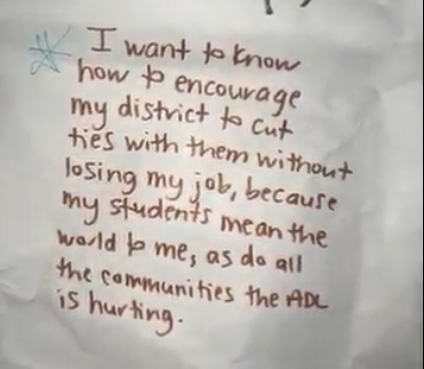
This is partly due to:
The near monopoly the ADL and a few other vendors have had on addressing social justice topics in many schools;
Their one-size-fits-all approach, which is less labor intensive than teacher-led and student- centered initiatives; and
The persistent underfunding of initiatives that offer higher-quality, truly antiracist alternatives.
In order to respond to the particular needs of your school community and genuinely promote the safety, belonging, and learning of all students, including those from all marginalized communities, we recommend that you develop your own antiracist and social justice expertise if at all possible. Work with your educators’ union to find ways to identify and compensate teachers within your school to champion your antiracist programming and bias incident response. When you do need to contract with outside organizations, consider the following criteria as you evaluate and select training, curriculum, and programming:
Criteria for Contracting with External Advisors
To ensure that your school, community or educational institution not become complicit in attacks on academic freedom, the freedom to teach, the right to learn, the obligation to teach truth, and that it does not create discrimination against other groups, you should make sure that you do partner with consultants and organizations that:
Align with all of the values and principles about diversity, equity, inclusion, belonging and justice articulated by your school or school district.
Recognize historical and social context when addressing social justice issues.
Distinguish between the varying and disproportionate impacts of discrimination on different groups while upholding every group’s right to dignity.
Consistently defend the rights and wellbeing of all students and propose solutions that benefit all students.
Uphold the social justice practices they themselves espouse across their organizational work.
Are seen as credible by and about a diverse range of communities.
Demonstrate responsiveness to good faith critiques of their pedagogy.
Avoid partnering with organizations that:
Have a demonstrated history of advocating for local, state, or federal policy or legislation that undermines public education or the job security and safety of educators who prioritize excellent teaching above political considerations.
Advocate local, state, or federal policy that censors or restricts the critical examination of the history or actions of the United States or any other nation-state.
Prioritize any educational approach that would protect the comfort of one ethnic, religious, or national group over the rights of another.
Seek to restrict discussion or lawful protest by students or educators about contentious topics on their campus.
Conflate criticism of Israel with antisemitism, or use statistics that consider protected political speech in support of Palestinian rights as antisemitic. (Schools operating in places that are using the IHRA definition of antisemitism must be especially careful to avoid partnering with organizations that promote censorship to protect a group from being discussed and/or criticized.)
Engage in speech or actions that target or threaten the wellbeing and rights of Palestinians, Muslims, Arabs, other people of color, and/or supporters of Palestinian human rights from any background.
Weaponize Title VI of the Civil Rights Act by suggesting that criticism of Israel creates a hostile environment for Jews (i.e., conflating Zionism with Judaism and essentially treating Zionists as a protected class) in an effort to bully institutions into changing their educational policies or programming.
Transparency and Community Input
We also suggest that schools and districts create a transparent process for considering community feedback about curriculum, professional development, and external advisors. The process should require challengers to provide evidence that the program in question fails to meet criteria of eligibility or acceptability that have been previously laid out by the school or district. It should be led by educators who are tasked to consider only the substance of the challenge, not to make a decision based on the number of complaints for/against a particular curriculum or vendor.
Be careful
When contracting with outside experts to enhance learning about antisemitism and racism for your school community, there is a need for caution. The ADL and many other organizations that are prominent in this field are divisive political advocacy organizations. These include the American Jewish Committee (AJC), the various local offices of the Jewish Community Relations Council and the Jewish Federations of North America, the Institute for Curriculum Services, and the Combat Antisemitism Movement, among others. These organizations have weaponized accusations of antisemitism against schools, educators and students in order to protect Israel from criticism. They have promoted state and local policies that are deeply hostile to Ethnic Studies programs and DEI initiatives. They have opposed calls for Palestinian human rights, including in the form of basic self-expression by Palestinian students and school staff. In short, school relationships with these organizations can suppress the freedom to teach and the right to learn.
Limited options, important decisions
Given the demands on your and your teachers’ time, as well as the funding limitations so many schools face, it is unfortunate that there are no other organizations that provide ready-to-use, no-cost materials or work at scale as the ADL does.